Tree removal on Long Island is not as simple as scheduling a crew and cutting a tree down. Depending on where you live, the size of the tree, and whether it's near a utility line, you may need a municipal permit, a PSEG notification, or both — before anyone picks up a chainsaw. This guide covers what Long Island homeowners actually need to know: permit rules by county, the PSEG coordination requirement that catches most people off guard, what the job typically costs, and what a professional removal includes from start to finish.
The PSEG Requirement Most Homeowners Don't Know About
Before removing any tree within striking distance of overhead power lines, you are required to notify PSEG Long Island. This applies whether the line runs along the street in front of your house or along a side or rear property line. The utility line clearance requirement exists because a falling tree or large limb can take down live wires — creating a hazard for your crew, your neighbors, and anyone near the lines when the tree comes down.
Many homeowners assume this is the contractor's problem. It is not. The homeowner carries the liability if work is done without proper PSEG coordination and something goes wrong. A tree company that skips this step is cutting corners in a way that could leave you exposed.
Long Island Tree Pros coordinates PSEG utility clearance as part of every removal job where overhead lines are a factor. We contact PSEG to arrange a line hold or protective covering when required, confirm the clearance before the crew starts, and document the coordination for your records. This is not optional on any job near utility infrastructure — it's the baseline for doing the work safely.
Permit Rules: Nassau County vs. Suffolk County
Long Island does not have a single tree removal permit standard. Rules vary by county, town, and incorporated village, and the variation is wide enough that what requires a permit in one municipality may not require one two miles away.
Nassau County. Many incorporated villages in Nassau require a permit before removing any tree with a trunk diameter of 6 inches or more at breast height (DBH — measured 4.5 feet from the ground). Garden City, Westbury, Mineola, Rockville Centre, and Lynbrook all have tree preservation ordinances on the books. Penalties for removing a regulated tree without a permit range from fines to requirements to replant multiple replacement trees. In some Nassau villages, the permit application requires a site survey and an arborist's statement of reason for removal.
Suffolk County. Suffolk does not have a county-wide tree permit requirement. Rules are set at the town level and vary significantly. Huntington has a Street Tree Permit for trees in the public right-of-way. Brookhaven has regulations tied to coastal overlay zones and wetland buffers. East Hampton has some of the most protective tree preservation laws on Long Island, requiring permits for removal of trees above certain size thresholds and imposing mitigation requirements. Southampton and Southold have their own standards. If you are in an incorporated village within a Suffolk town — say, Port Jefferson Village or Northport Village — the village may have separate rules on top of the town's.
The practical takeaway: before any removal, the first step is confirming whether a permit is required in your specific municipality. Long Island Tree Pros handles permit research and applications as part of the job. You do not need to figure out your town or village's rules on your own.
When Tree Removal Is Urgent vs. Scheduled
Not every removal follows the same timeline. The urgency of a job — and the approach to it — depends on why the tree needs to come down.
Emergency removal (storm damage, imminent hazard). After a nor'easter, hurricane, or severe thunderstorm, trees split, uproot, and land on structures, cars, and driveways. Emergency removal is time-sensitive work: the tree is already on the house, blocking the road, or hanging by a root ball over a fence. Long Island Tree Pros provides emergency storm response 24 hours a day, 7 days a week. Emergency work carries a premium — typically 30 to 50 percent over standard removal rates — because it requires immediate crew deployment, sometimes in the middle of the night, and involves working around structural damage.
Diseased or declining trees (planned removal). A tree with advanced oak wilt, severe beech leaf disease, or structural decay from a fungal infection may not be an immediate hazard today but becomes one over time. Planned removal can be scheduled at a time that works for you, allows time to pull any required permits, and lets the crew prepare a rigging plan for tight-access situations. There is no urgency premium.
Construction clearance. New additions, pool installations, garage builds, and driveway expansions often require clearing trees from the work footprint. This is the most schedule-flexible category — you have lead time to pull permits, arrange PSEG coordination for any lines in the area, and schedule the crew before construction begins.
Utility clearance. Trees growing into power lines, phone lines, or cable infrastructure are often flagged by utilities or noticed by homeowners after a close call during a storm. PSEG may contact you directly if a tree on your property is encroaching on their infrastructure. These jobs require coordination with the utility regardless of who initiates the call.
Cost Breakdown: Tree Removal on Long Island
Removal costs are driven by tree size, access, proximity to structures, and whether crane rigging is needed. The following ranges reflect typical 2026 pricing across Nassau and Suffolk County.
Small tree (under 30 feet). Ornamental trees — crabapple, dogwood, ornamental pear, young cherry — fall in this range. Expect $350 to $700 for a straightforward removal with reasonable access.
Medium tree (30 to 60 feet). Silver maple, pin oak, Norway spruce, linden, and most mature landscape trees fall here. Expect $800 to $1,800. The wide range reflects access difficulty: a medium oak in an open backyard costs less than the same size tree over a pool with fence constraints.
Large tree (over 60 feet). Mature white oak, red oak, Norway maple, and large red maple removals start around $1,500 and can reach $3,500 or more for trees with difficult access, multiple stems, or proximity to the house. Very large canopy trees requiring crane-assisted rigging can exceed $5,000.
Stump grinding. Standard stump grinding is priced by stump diameter — expect $150 to $400 per stump. Grinding removes the visible stump to 6 to 12 inches below grade. Root systems remain but decay naturally. For replanting over the stump site, grinding deeper or full root excavation may be needed at additional cost.
Log splitting. If you have a fireplace or know someone who does, crews can split and stack the cut wood rather than hauling it away. This is usually a no-cost or low-cost option, and it eliminates hauling fees on the wood portion of the job.
For a detailed breakdown of costs by scenario, see our tree removal cost guide for Long Island.
What's Included in a Full Removal
A professional tree removal by Long Island Tree Pros includes the following:
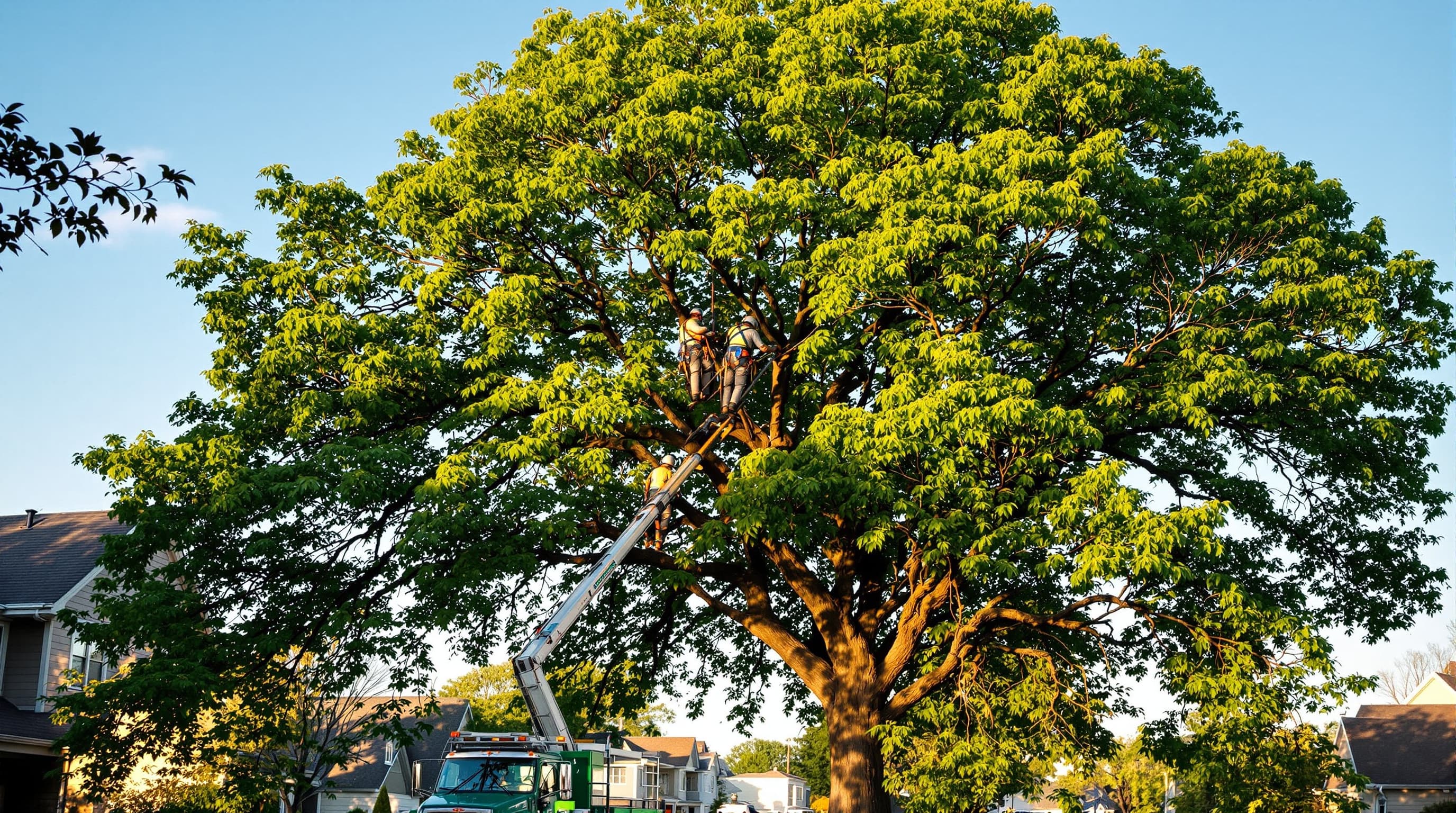
Crew and equipment. A typical removal involves a lead climber or crane operator, ground crew, and a chipper. For large trees over structures, a crane is deployed rather than relying solely on rigging from the tree.
Section-by-section removal. The tree comes down in controlled sections, not as a single fell. Each section is rigged, lowered, or craned off the property to avoid damage to fences, pools, irrigation systems, and neighboring property.
Full haul-away. All debris — brush, branches, and cut wood — is chipped on site and hauled off. No piles left in the yard.
Log splitting option. Larger sections can be split and stacked for firewood instead of chipped.
Stump grinding (as add-on or included). Depending on the job quote, stump grinding may be included or priced separately. We'll specify in the estimate.
Site cleanup. The crew rakes, blows, and removes chip debris from the work area before leaving.
Nassau County Villages With Mature Tree Canopy
Some of the highest-complexity removal jobs on Long Island come from Nassau County villages with dense canopy cover and tight lot configurations. Communities like Garden City, Merrick, Bellmore, Seaford, and East Rockaway have mature oaks and maples that were planted 60 to 80 years ago when lots were first developed. These trees are now 60 to 90 feet tall, overhanging rooflines, garages, inground pools, and neighboring properties. Removal in these villages frequently requires crane work, permit applications, and PSEG coordination all at once — which is exactly what Long Island Tree Pros is set up to handle. Trees you decide to keep over a roof will still fill the gutters with leaves and seeds, so it helps to know whether gutter guards are worth it under big trees.
Nassau and Suffolk Coverage
Long Island Tree Pros serves Nassau and Suffolk County homeowners and commercial properties, including:
Nassau County: Garden City, Mineola, Westbury, Levittown, Hicksville, Plainview, Syosset, Jericho, Merrick, Bellmore, Seaford, Wantagh, Massapequa, Rockville Centre, Valley Stream, Lynbrook, Freeport, Uniondale, East Meadow, Floral Park, New Hyde Park, Elmont.
Suffolk County: Huntington, Melville, Commack, Hauppauge, Smithtown, Stony Brook, Port Jefferson, Setauket, Centereach, Lake Grove, Ronkonkoma, Bohemia, Bay Shore, Islip, Brentwood, Central Islip, Patchogue, Sayville, West Babylon, Babylon, Lindenhurst.
Frequently Asked Questions
Do I need a permit to remove a tree on Long Island?
It depends on your municipality. In many Nassau County villages, a permit is required for any tree 6 inches or more in diameter (measured at 4.5 feet from the ground). In Suffolk County, requirements vary by town and village — some have strict preservation ordinances, others have minimal requirements. Long Island Tree Pros checks the permit rules for your specific address before any removal begins.
Why do I need to notify PSEG before removing a tree?
Any tree within striking distance of overhead utility lines poses a hazard to the crew and the public if it falls on live wires. PSEG Long Island requires notification so they can arrange a line hold or install protective coverings before the work starts. Skipping this step creates liability for the homeowner. We handle PSEG coordination on every applicable job.
How much does tree removal cost on Long Island?
Small ornamental trees under 30 feet typically run $350 to $700. Medium trees (30 to 60 feet) run $800 to $1,800. Large trees over 60 feet start around $1,500 and can exceed $3,500 depending on access and rigging complexity. Crane-assisted removals can run higher. Stump grinding is $150 to $400 per stump.
What happens to the wood and debris after removal?
All brush and branches are chipped on site and hauled away. Larger sections of trunk and main branches can be split into firewood and stacked for you at no additional charge, or chipped and removed if you prefer. The site is raked and cleaned before we leave.
Do you do emergency tree removal after storms?
Yes. Long Island Tree Pros provides emergency storm response 24/7. If a tree has come down on your house, car, fence, or is blocking your driveway after a storm, call us and we dispatch a crew. Emergency rates carry a 30 to 50 percent premium over standard removal pricing due to immediate dispatch and after-hours work.
Do you grind the stump after removal?
Stump grinding is available on every removal job — either included in the original quote or as a separate add-on. We grind to 6 to 12 inches below grade as standard. If you plan to replant directly over the stump site, let us know and we'll grind deeper. For context on typical stump grinding costs, see our blog post on stump grinding costs on Long Island.
---
Long Island Tree Pros serves Nassau and Suffolk County homeowners with ISA Certified Arborist-led removal, permitting, and PSEG coordination. Get a free estimate or read our guide to arborists on Long Island to understand credentials and what to look for when hiring.